Autonomous delivery is no longer a futuristic concept—it’s rapidly becoming part of everyday life. If you’re searching for clear, up-to-date insight into the autonomous delivery robots evolution, you likely want more than headlines. You want to understand how the technology has progressed, what breakthroughs are driving it forward, and what it means for cities, businesses, and consumers right now.
This article breaks down the major milestones in robotics, AI navigation, sensor systems, and last-mile logistics that have shaped today’s delivery robots. We examine real-world deployments, emerging innovations, and the technical challenges still being solved.
Our analysis draws on the latest advancements in AI, robotics engineering, and smart infrastructure research, ensuring you get accurate, forward-looking insights grounded in current technological developments.
By the end, you’ll have a clear picture of where autonomous delivery stands today—and where it’s heading next.
From sci-fi fantasy to curbside reality, six-wheeled bots glide past coffee shops like something out of Star Wars. Their story is the autonomous delivery robots evolution in action. At stake is the last-mile problem—the final leg of delivery, often the costliest segment of a supply chain. Consider two paths:
• Human couriers: flexible, but expensive and limited by labor shortages.
• Autonomous bots: scalable, data-driven, yet dependent on AI maturity and regulation.
Critics argue robots clog sidewalks and cut jobs. Supporters counter that routing algorithms and robotics advances reduce emissions and costs. Tomorrow’s quantum-enhanced networks may decide which model wins.
Generation One: The Rolling Coolers That Started It All
The Pioneers of the 2010s
First came the “rolling coolers.” Companies like Starship Technologies deployed small, six-wheeled robots that looked less like sci‑fi and more like Igloos on a mission. Technically, they were autonomous delivery units—meaning machines capable of navigating without constant human control—but in practice, they relied heavily on people behind the curtain.
Their initial tech stack combined GPS (satellite-based positioning), ultrasonic sensors (sound-wave obstacle detection), and frequent remote human oversight. Think autopilot versus a fully self-driving car: A vs B. Generation One leaned closer to autopilot. When confused, a human operator stepped in (yes, like a drone pilot for your sandwich).
Because of these limits, deployments stayed inside controlled “operational sandboxes” such as university campuses and corporate parks. Smooth sidewalks, predictable traffic, minimal chaos. Compared side-by-side with open city streets—unpredictable pedestrians, harsh weather, complex curbs—the difference was night and day.
However, their weaknesses were clear: slow speeds, curb paralysis, and rain vulnerability (robots and puddles were not friends). Studies showed early pilots required significant remote intervention to maintain safety (Starship Technologies reports, 2018).
Still, the primary achievement was cultural. They proved the concept worked. The autonomous delivery robots evolution had officially begun—and people didn’t panic when a cooler rolled by (always a good sign).
Pro tip: Early adoption in low-risk zones often signals where breakthrough tech will scale next.
Generation Two: Seeing and Thinking in the Urban Jungle
The Sensor Fusion Leap
At first glance, adding more sensors sounds like overkill. Some critics argue that LiDAR (Light Detection and Ranging, a laser-based system that measures distance), high-resolution cameras, and radar simply duplicate effort and inflate costs. However, when fused together—sensor fusion meaning the blending of multiple data streams into one coherent model—these tools create a detailed 360-degree map of city streets. Cameras capture color and texture, radar sees through rain and fog, and LiDAR builds precise depth maps. In other words, it’s less redundancy and more teamwork (think Avengers, but with fewer capes).
The AI Brain
Of course, hardware alone is useless without intelligence. Onboard machine learning models—algorithms trained on vast datasets to recognize patterns—enable real-time object detection, from pedestrians and cyclists to pets darting off leashes. Some skeptics worry AI can’t predict human chaos. Yet predictive pathfinding, which anticipates likely movements based on past behavior, has steadily improved through edge computing, where data is processed directly on the robot instead of the cloud. Consequently, response times shrink to milliseconds.
Tackling Urban Complexity
Crosswalk negotiations, curb climbing, and unpredictable foot traffic once stalled progress in the autonomous delivery robots evolution. Nevertheless, improved motion planning systems now adapt dynamically, slowing, rerouting, or pausing as needed. (Yes, sometimes they’re more polite than humans.) Pro tip: redundancy in perception systems dramatically boosts safety margins.
Innovation Spotlight
Self-righting mechanisms allow robots to flip back upright after a fall, minimizing downtime. Meanwhile, modular payload bays adjust temperature and insulation—keeping ramen hot and parcels secure. Critics call it incremental. I call it survival in the concrete jungle.
Generation Three: The Hive Mind and Smart City Synergy
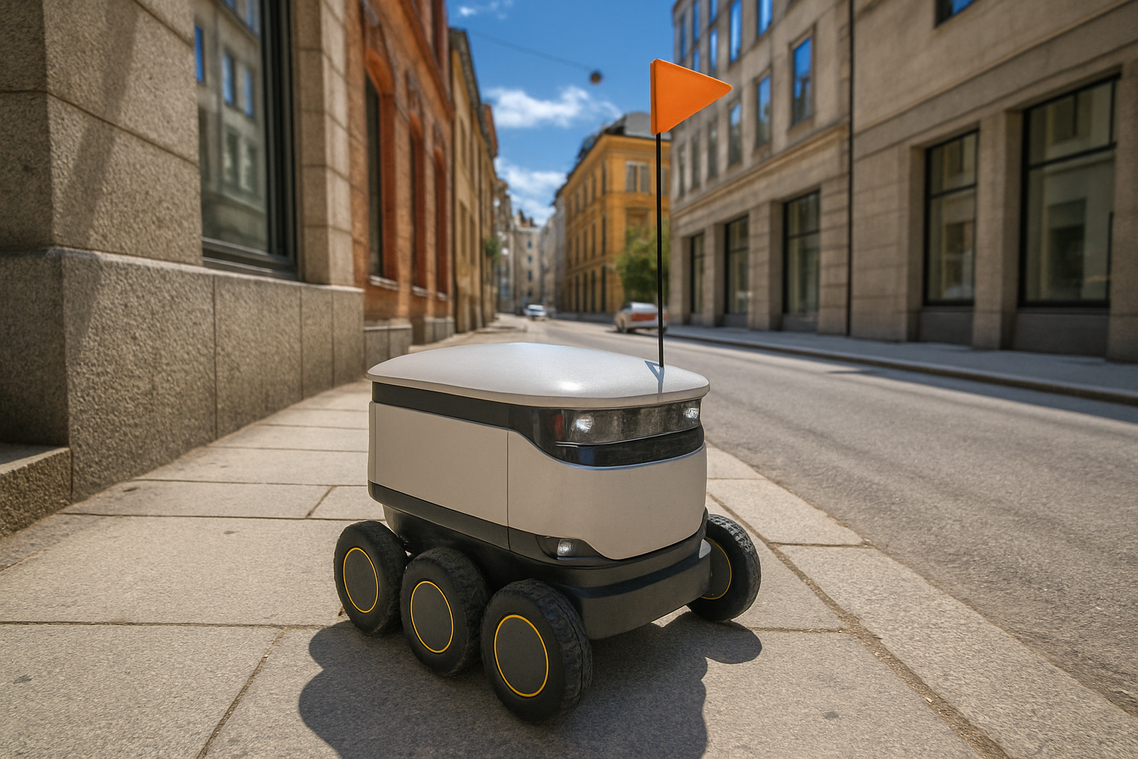
Generation Three marks the moment autonomous delivery robots evolution stopped being about solo machines and became about collective intelligence. Swarm intelligence—where multiple robots coordinate like a colony of ants—allows fleets to share route data, reroute around congestion, and balance workloads in real time. Think less “lone courier” and more Avengers assemble (but with better traffic discipline).
Vehicle-to-Infrastructure (V2I) communication takes this further. Robots now “talk” to traffic lights, curb sensors, and building systems to request green-light priority or elevator access. This reduces idle time, which studies show can account for up to 30% of urban delivery delays (McKinsey, 2023).
Above it all sits a centralized cloud brain—a master AI hub predicting demand spikes, optimizing battery cycles, and dispatching units with algorithmic precision.
Then come mothership vans: larger vehicles that deploy compact bots into tight neighborhoods, forming hyper-local rapid networks (sci-fi vibes, real-world logistics).
What You Should Do
- Prioritize cities investing in V2I infrastructure for pilot programs.
- Adopt centralized fleet management early to future-proof scaling.
- Explore cross-sector AI insights, such as those discussed in ai in healthcare diagnostics current capabilities and limits.
Pro tip: Start small with a swarm cluster before citywide rollout—optimization improves exponentially with data density.
The Next Frontier: Quantum Routing and Self-Sustaining Hardware
Quantum computing promises to crack routing nightmares like the Traveling Salesman Problem—an optimization puzzle where finding the shortest possible route across many stops overwhelms classical computers. In theory, a quantum system could recalculate an entire քաղաքի delivery grid in seconds. However, experts still debate scalability and error correction limits (we’re not quite at sci‑fi levels yet).
Meanwhile, hardware is evolving just as quickly. The autonomous delivery robots evolution now includes:
- Legged robots that climb stairs and sidestep debris
- Hybrid drone-bots capable of rooftop and balcony drops
- Modular frames that swap tools mid-route
Still, agility introduces maintenance complexity. That’s where self-diagnosing systems come in—embedded sensors that flag wear before breakdowns occur. Predictive maintenance, defined as AI-driven failure forecasting, could reduce downtime dramatically (McKinsey estimates predictive strategies cut maintenance costs by up to 30%).
And yet, can “mechanic bots” reliably repair peers in the field? It’s plausible. But real-world durability data remains limited.
The Unstoppable March of Automated Logistics
From simple wheeled containers trundling across campuses to intelligent, city-integrated swarms, the autonomous delivery robots evolution has been swift. What began as novelty now resembles infrastructure.
Consider A vs B:
- Human couriers: flexible but costly, traffic-bound, inconsistent.
- Autonomous fleets: data-driven, scalable, operating 24/7 (no coffee breaks required).
Critics argue robots lack the nuance of human drivers. True—for now. Yet each software update chips away at that gap, systematically dismantling last-mile inefficiency and cost (McKinsey, 2023).
Innovation is compounding. Sensors improve, AI optimizes routes, cities adapt. The delivery robot isn’t a gimmick; it’s the backbone of an automated, on-demand economy.
The Road Ahead for Autonomous Innovation
You set out to understand where next-generation automation is heading — and now you’ve seen how breakthroughs in AI, robotics, quantum computing, and especially the autonomous delivery robots evolution are reshaping the real world.
Innovation moves fast. The real challenge isn’t access to information — it’s keeping up before you fall behind. Missing a key development today could mean playing catch-up tomorrow.
Now that you have a clearer view of the trends driving intelligent machines and smart infrastructure, the next step is simple: stay informed, stay adaptive, and actively explore how these technologies apply to your projects or investments.
If you want reliable innovation alerts, deep dives into emerging tech, and practical tech maintenance tutorials all in one place, start following our updates today. Join thousands of forward-thinking readers who rely on us for cutting-edge insights — and make sure you’re prepared for what’s coming next.