

Manufacturing is entering a new era—and if you’re here, you likely want to understand how collaborative robots in manufacturing are reshaping production floors right now. From boosting efficiency to addressing labor shortages, these advanced robotic systems are no longer futuristic concepts; they’re practical tools transforming how factories operate.
This article breaks down what collaborative robots actually do, how they integrate with human teams, and why companies of all sizes are investing in them. We’ll explore real-world applications, key technological advancements driving adoption, and what this shift means for productivity, safety, and long-term competitiveness.
Our insights are grounded in ongoing analysis of robotics innovation, AI integration trends, and emerging industrial automation data. By examining verified industry reports and current deployment case studies, we provide a clear, up-to-date perspective you can rely on.
If you’re evaluating automation strategies or simply want to understand where modern manufacturing is headed, this guide will give you the clarity you need.
The new coworker
As manufacturers increasingly turn to collaborative robots to enhance productivity and precision on the factory floor, the intersection of automation and advanced technologies, like high-speed quantum processing, opens up exciting new possibilities for optimizing operations while also presenting unique risks that should not be overlooked – for more details, check out our Real-World Applications of High-Speed Quantum Processing.
The assembly line isn’t dying; it’s EVOLVING. Instead of fenced-off machines, factories deploy collaborative robots in manufacturing that work shoulder to shoulder with people. Critics argue robots still threaten jobs. Fair point. Yet data from the International Federation of Robotics shows automation shifts workers into higher-skill roles rather than eliminating them (IFR, 2023).
What competitors miss is micro-collaboration layer:
- Real-time force sensing that stops on human contact
- AI vision that learns from operator gestures
- Modular tooling swapped in minutes
Think less Terminator, more Iron Man suit (with goggles). PRO TIP: pilot cobots on repetitive, injury-prone stations first.
From caged giants to agile partners: what makes a robot “collaborative”?
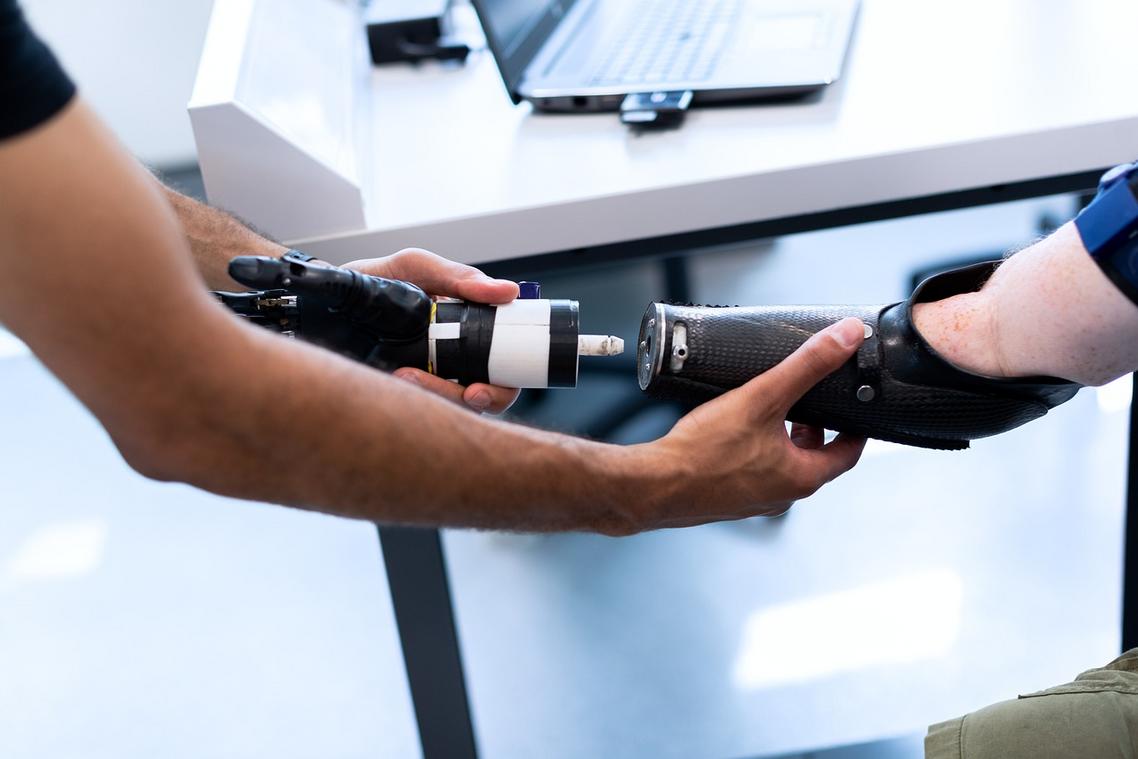
For decades, industrial robots were the “caged giants” of the factory floor—massive, fast, and fenced off for safety. A collaborative robot (or cobot) is different: it’s built to operate safely beside humans in a shared workspace, not behind steel barriers.
So what makes that possible?
-
Advanced Safety Sensors: Cobots use force and torque limiting sensors—devices that measure resistance in joints. If the arm bumps into a person, it detects the abnormal force and stops instantly. (Think of it like a reflex, not a reboot.) According to ISO 10218 safety standards, this force-limiting design reduces injury risk in human-robot interaction.
-
Vision Systems: Cameras and depth sensors create 3D spatial awareness. If a worker steps closer, the cobot slows or reroutes. It’s less “blind automation,” more situational awareness.
-
Intuitive Programming: Instead of complex code, operators can hand-guide the arm to “teach” motions. This lowers the skill barrier significantly.
Some skeptics argue collaborative robots in manufacturing can’t match the speed of traditional systems. That’s fair, speed is often capped for safety. But flexibility and reduced downtime frequently offset that tradeoff.
Speculation: As AI perception improves, cobots may anticipate human intent—handing over tools before you ask (very Iron Man workshop energy). The cage may soon feel like ancient history.
Four key collaborative processes on the modern factory floor
Walk onto a modern factory floor and you’ll notice something subtle but powerful: humans and robots working side by side like dance partners who’ve finally learned each other’s rhythm. While skeptics argue automation replaces people, the reality of collaborative robots in manufacturing looks more like a well-rehearsed duet than a hostile takeover.
1. Co-assembly and fastening
First, consider co-assembly. Here, a cobot acts as a steady “third hand,” holding a heavy or awkward component in perfect position while a technician performs wiring or precise fastening. Think of it like a camera tripod for your hands, stable, patient, and never fatigued. Critics sometimes claim fixtures and jigs can do the same job. However, cobots adapt in real time, adjusting angles without expensive retooling. The result? Faster changeovers and fewer ergonomic injuries (and fewer muttered complaints about back pain).
2. Machine tending and part feeding
Meanwhile, machine tending turns into a tag-team sport. The human sets up the CNC machine, fine-tunes programs, and oversees quality. The cobot loads raw stock and unloads finished parts with metronomic consistency. Some argue a fully automated cell would be more efficient. Yet full automation can be rigid and costly. A cobot-assisted setup is more like cruise control than autopilot: the operator remains in command while repetitive strain disappears.
3. Collaborative quality inspection
Next comes inspection, a process often compared to proofreading a novel. A cobot equipped with high-resolution vision systems scans and measures thousands of dimensions per shift, flagging anything outside tolerance (meaning outside acceptable measurement limits). The human then applies contextual judgment. Machines bring consistency; humans bring intuition. It’s less “man versus machine” and more Sherlock Holmes with a microscope.
4. Finishing and polishing
Finally, in sanding or deburring, cobots handle repetitive pressure and motion, like an endlessly patient apprentice. The worker focuses on complex corners and final touches. This partnership reduces repetitive stress injuries while maintaining craftsmanship.
In many ways, this shift mirrors the evolution described in the evolution of autonomous delivery robots. Automation doesn’t erase people; it reshapes roles. And on today’s factory floor, that reshaping feels less like replacement—and more like reinforcement.
Productivity hums differently when humans and machines share the floor. Cycle times shrink; bottlenecks loosen like a stubborn jar lid finally twisting free. The synergy is tangible: tasks flow from steady human hands to precise robotic joints without the usual clatter of stop and start. In facilities adopting collaborative robots in manufacturing, throughput rises because the combined output exceeds what either could achieve alone (think buddy cop movie energy, but with torque).
Safety shifts too. The air no longer carries the sharp intake of breath before a heavy lift. Back strain and repetitive motion injuries decline as robots shoulder the grinding, spine compressing work (OSHA notes musculoskeletal disorders account for nearly 30% of manufacturing injuries).
Agility becomes visible in the way cells reconfigure overnight. Cobots roll to new stations, software updated with a few taps, supporting high mix, low volume runs without the oily scent of massive retooling.
Most importantly, roles evolve. Workers listen to softer motor whirs while analyzing data dashboards, becoming operators and process optimizers rather than pure labor. PRO TIP: invest in cross training early.
• CAPS
•
•
This is not replacement; it is EMPOWERMENT YOU CAN HEAR IN THE RHYTHM OF PRODUCTION.
Manufacturing has already learned an important lesson: the magic happens when people and machines team up. The rise of collaborative robots in manufacturing proved that blending human creativity with robotic consistency beats a winner‑takes‑all showdown every time. Humans spot nuance; robots handle repetition without coffee breaks (or complaints about the thermostat).
Now, looking ahead, AI and machine learning are turning cobots into quick studies. Instead of waiting for precise programming, these systems observe, adapt, and refine tasks in real time. In other words, your robotic teammate won’t follow instructions, it’ll anticipate them. Think less “clunky assembly line” and more “Iron Man suit,” minus the billionaire ego.
Some argue full automation is the endgame. However, factories that sideline people often lose flexibility and problem-solving depth. The smarter path is augmentation. Ultimately, the future belongs to a tech-augmented workforce where ingenuity directs robotic precision, unlocking levels of quality, safety, and productivity.
The future is closer than you think
You set out to understand where emerging technology is headed — and now you’ve seen how AI breakthroughs, quantum computing advances, smart automation, and collaborative robots in manufacturing are actively reshaping industries.
The pace of innovation isn’t slowing down. If anything, it’s accelerating. And the real risk isn’t that technology will change , it’s being unprepared when it does.
Staying informed isn’t just about curiosity. It’s about protecting your relevance, sharpening your competitive edge, and making smarter decisions in a world driven by intelligent systems.
Here’s your next move: get real-time alerts when something shifts in your space, dig into what actually matters in new tech, and grab maintenance tutorials that work. Thousands of readers already trust us—and they’re not waiting around for insights that arrive too late.
Don’t wait for the future to surprise you. Stay informed, stay prepared, and step confidently into what’s next.